


On February 25th, 1866, work began on the railway according to the project by Engineer Borella, by workers from Cesare Debernardi Enterprises, while the laying of the rails was carried out by the italian Railway Engineer Regiment under the orders of Capt. Boetti. The “Ciriè – Lanzo railway line” as it is still called by inhabitants of Venaria, in addition to facilitating moving passengers around, paved the way for the settlement on its territory of industrial factories and even the military apparatus present in the city at the time benefited from it.
The Venaria Reale station was built in 1867 by the Engineer Capuccio and was inaugurated on March 7th, 1871. Its architecture is an anomaly and an “unicum” compared to the Italian railway stations built in the same years, as the passenger building was, and still is, a two-story building located perpendicular to the tracks, straddling them, with access to the tracks permitted by a flight of stairs.
Bertolotti, referring to the station of Venaria, wrote in 1872: “The station of Turin is beautiful; the one of Veneria Reale was built astride the railway, on the highway, which goes from Turin to Altessano. It was built on the basis of a vague design and it has a kiosk, in which there is a Cafe. To get out of it you can climb up comfortable stairs, and a beautiful avenue with pruned huisaches then leads to Veneria.”
About ten years later Carlo Ratti in his book “From Turin to Lanzo to the Stura Valleys” describes the railway station of Venaria Reale with almost the same words: “This [station], a bit original in design, is built astride the railway; then to get out of it you climb up a ladder and you leave again on the road that comes from Turin”.
Venaria Reale and “its” railroad
In Venaria Reale the Ciriè – Lanzo, as it is still indicated by people in common speech, despite its extension to Ceres, comes from Madonna di Campagna and grafts in the city territory in the Brentatore Region parallel to the route Corso Piemonte; then it crosses the ring road and continues next to Corso Garibaldi as far as the station of viale Roma, then it passes first the Ceronda and then the Stura and it continues towards Borgaro.
Already in 1827 the Venaria Reale City Council, at its meeting of 11th February, examined the proposal for a contribution to the costs of building a railway line between Turin and Ciriè. The request was 36,000 lire and this would have meant starting a mortgage at the Banca Nazionale di Sconto (an italian bank). The price appeared to be excessive for the meagre finances of the municipality and therefore the proposal was put aside.
Despite this renunciation, the problem of the connection between Venaria and Turin was now posed: the difficulties to cover the 8 km that separated Piazza dell’Annunziata from the center of Turin, began to be felt especially for traders, artisans and the workers who then worked in the area of Turin and for those who came from the subalpine city to work in Venaria (Ballone, Racca 1998, p. 409).
The City Council took note and later when Engineer Gaetano Capuccio presented a new railway project, this was received with much favor. In fact, in 1862 when the Società Canavese per la Strada Ferrata da Torino a Ciriè (Canavese Society for the Railway between Turin and Ciriè) was established, the Municipality joined immediately and enthusiastically and after it had decided “to consult the part of the population most interested in such an establishment”, on June 25th, 1865 the City Council approved the purchase of shares of this company for a value of 150,000 lire. This brilliant initiative of Venaria Reale, in addition to facilitating the movement of people, facilitated the settlement on its own territory of industrial factories (Maschio 2020, p. 82).
A phase not always linear, sometimes even conflictual, followed between the Municipality of Venaria Reale and the Direction of the company responsible for the construction of the line. Also the operations of expropriation of land on which the railway would then pass found hitches and difficulties (Ballone, Racca, pp. 412 and 413).
Finally, on April 18th, 1868, the first stretch of the railway between Turin Ponte Mosca and Venaria Reale was inaugurated and on November 30th of the same year the Venaria Reale – Caselle Torinese section was also inaugurated. The ceremony of inauguration in Venaria occurred on the occasion of the wedding between the hereditary princes Umberto and Margherita. The duration of the train ride was 15 min., and 9 runs a.r. were planned throughout the day. The cost of the ticket was fixed in L. 0.70 for the 1st class, L. 0,40 for the 2nd class and L. 0,25 for the 3rd one (GAZZETTA PIEMONTESE of 19th April 1868).
The bridges over the Ceronda and Stura rivers
The service of the railway line, due to the torrential regimes of the Ceronda and the Stura was immediately problematic. In fact, in October 1872 the original single-beam metal bridge, who measured 27.3metres, placed on the Ceronda immediately after the Venaria Reale Station, was taken down by a flood, without causing casualties. To restore service, the transfer was replaced by a temporary wooden one and a new metal span.
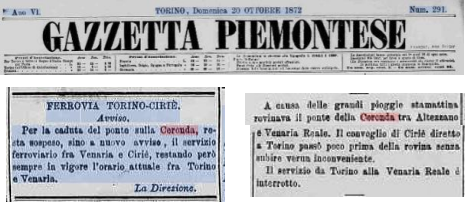
This work will last until September 1938 when a violent flood will drag it away. A Bailey1 Engineering Bridge was replaced in 1947 by a three-light reinforced concrete bridge. Also this bridge will suffer damage in July 1973 due to a further flood of the stream: one of the two shoulders collapsed and was then rebuilt only in 1975 (LA STAMPA of 15 July 1973, p. 4).
The other bridge over the Stura di Lanzo stream, located about 600 meters north of the previous one, will not have better luck. On 23rd September, 1920, following a heavy flooding of the Stura three bays and two pillars collapsed. The newspaper La Stampa of 25th September wrote: “As a result of the bad weather, an impetuous flood brought down the bridge of Venaria Reale on which the Turin-Lanzo railway passes. There are no casualties, but the railway service is interrupted” (LA STAMPA of 25th September 1920, p. 2).
The collapsed bridge was built in masonry, with three arches along about seventy meters. The railroad company arranged for a Pontieri military unit to rebuild an intermediate stack and laid a Bailey bridge which remained in operation until 1947. In the meantime service was guaranteed with a transfer of passengers to and from Borgaro with cars. On September 30th, the transfer of passengers with hand luggage will be carried out with a pedestrian walkway. On 23rd November the Society of management communicates that the railway service, interrupted for the collapse of the bridge, will resume normally. (LA STAMPA 23 November 1920, p. 3).
A few years later, on 14th May 1926, a violent hurricane hit the valleys of Lanzo, and in particular Venaria was heavily affected. The Turin – Lanzo railway was interrupted between Venaria and Borgaro, because of the Stura in flood that flooded the surrounding countryside and made the railway bridge unsafe. La Stampa writes: “The inconvenience of passengers was high because the transhipment service did not always work. After a few days the situation normalized and the solidity of the bridge was verified, the service was resumed regularly. The damage caused by the flood, which affected all of Piedmont, was considerable.” (LA STAMPA of 17 May 1926, p. 6).
In September 1947 a new full sweep away the bridge arranged by military dockers in 1920. The news is picked up in the newspapers very prominently. The Press of 26 September wrote: “Due to a storm the impetuous waters of the Stura river brought down the iron bridge of the Turin-Lanzo railway. The first train consisting of a locomotive and two wagons had just passed when the head of the bridge collapsed and the arches were carried away as far as the middle of the river. The swirling waters of the river had eroded the land nearby by sliding two wagons into the river stopped on the railway. The service between the station of Venaria Reale and Borgaro will be carried out with vehicles made available to the soc. Torino Nord running the line” (STAMPA SERA of 26th September 1947, p. 1 and STAMPA SERA of 14 January 1948, p. 2).
To restore the service, a new Bailey bridge was built, inaugurated on January 14th, 1948, which lasted until November 8th, 1962, the date of a further flood that hit the entire Turin area violently.
“After 3 days of rain, the bridge over the Sangone, on Viale Stupinigi in Turin and, in Venaria Reale, the railway bridge over the Stura collapsed. At 6.30 am the bridge of the Torino-Lanzo line collapsed under the force of the water, interrupting the functionality of the service. The service has been replaced with coaches” (LA STAMPA del 9 November 1962, p. 5).


1The Bailey Bridge is a type of bridge, of military origin, named after its creator the British engineer Donald Bailey. Its peculiarity is the realization with modular elements, usually steel lattice beams and decked with wooden axes, which allowed a great speed of assembly and disassembly.
The Ferrovie Torino Nord Society stated that they were not able to afford the costs of rebuilding the bridge. For this reason the Ministry of Transport in January 1963, revoked the concession to the company and appointed a commissioner, who provided in 1963 for the construction of the new bridge that will be inaugurated on 7 November 1964, in the presence of the undersecretaries Mannironi and Donat-Cattin.
The Venaria Reale Station
The Venaria Reale station was built in 1867 by the Engineer Capuccio and was inaugurated on March 7th, 1871. Its architecture is an anomaly and an “unicum” compared to the Italian railway stations built in the same years, as the passenger building was, and still is, a two-story building located perpendicular to the tracks, straddling them, with access to the tracks permitted by a flight of stairs.


From the photographic documentation it appears that at the end of the ‘800s and the beginning of the ‘900s the town station was raised by one floor. (No official documentation was found of this and therefore, besides not knowing the exact date, the reasons for this intervention are unknown).
At the turn of the 80s and 90s of the last century, the building had to be demolished due to the work of doubling the track and in its place a new building in post-modern style was built. Also this building is placed straddling the railway of 3 tracks (one of which is of service), and presents itself with only one floor above ground and a pitched roof with steel structure and sheet metal cladding. The station was reopened on December 21st, 1991.

On the occasion of the construction of the new station, the SATTI Society also builds a pedestrian walkway that connects Corso Garibaldi with Via Fabio Filzi. The idea promoted by the City Council at that time was to shorten the distances between the center of Venaria and the one of Altessano. The walkway also provided for the descent, with two flights of stairs, towards the platforms of the station on the side of the tracks. This new artifact did not immediately enter into operation, due to lack of testing and bureaucratic shackles.
Close to the station, from 1888 until 1951 the interchange with trains in service on the Turin-Venaria Reale tramway was made possible. There is currently an interchange with the bus lines 11 and SF2 that serve to ensure the connection with the station of Turin Porta Susa. In addition to the historic station, Venaria Reale uses the Rigola – Stadium, a railway station also located on the railway line Turin – Lanzo – Ceres. Located in the Rigola district, on the border with the Turin district Barriera di Lanzo, it was built for the 1990 World Cup, in conjunction with the construction of the stadium of the Alps in the area of a disused chemical factory.
Entered into service on 17th December 1991, the station is composed of two passing tracks, a passenger building used as a ticket office, some platforms and roof canopies. There is an overpass above the station cycle-pedestrian and road that crosses the rails.
The second station of Venaria Reale has been redeveloped for the 2013-2014 UEFA Europa League final, held on 14th May 2014 at the Juventus Stadium in Turin, between the Spanish of Seville and the Portuguese of Benfica, in order to transport foreign fans coming from the airport of Caselle headed to the stadium.